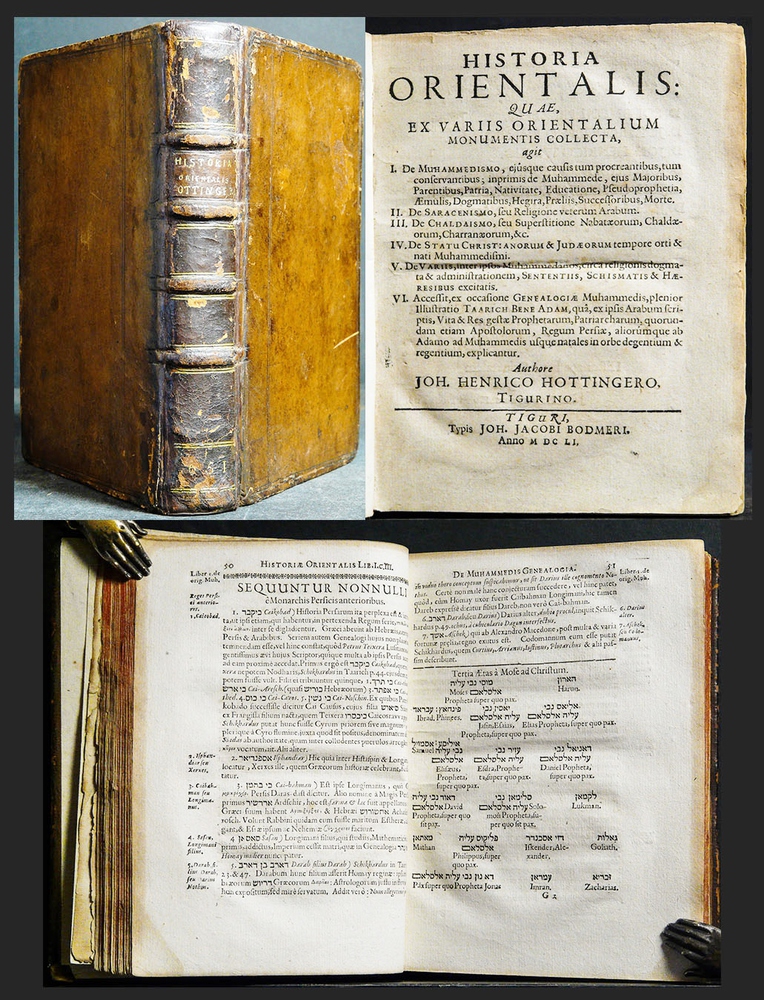
Hottingero, Johann Heinrich (1620-1667): Historia orientalis quae ex variis orientalium monumentis collecta, agit I. De Muhammedismo, …, II. De Saracenismo …. III. De Chaldaismo … . IV. De statu Christianorum & Judaeorum tempore orti & nati Muhammedism. V. De variis, inter ipsos Muhamme – Old and Rare
€1.200,00
HOTTINGER, Johann Heinrich , (1620-1667)
HISTORIA ORIENTALIS Tiguri (Zürich), Typis Joh.
Jacobi Bodmeri, Anno MDC.LI (1651)
Description: [in 4to] – pp. (16), 373, (23), (b). ORIGINAL
EDITION.
A rare and remarkably well preserved copy of this
important work on the origins of Islam and progression of the
philosophy, doctrine and teachings of Mohammed in the middle
east. It covers the the entire life of Mohammed, analizes his teachings putting them in
historical perspective with the old Arab traditions, Saracenism, but also Chaldaism and the
overall state of Christianity and Judaism at the time of Mohammed. A prominent orientalist
Johann Heinrich Hottinger (1620-1667), studied at Geneva, Groningen and Leiden. He was
appointed professor of Ecclesiastical history in his native town of Zürich in 1642. The chair of
Hebrew at the Carolinum was added in 1643, and in 1653 he was appointed professor
ordinarius of logic, rhetoric and theology. He gained such a reputation as an Oriental scholar
that the elector palatine in 1655 appointed him professor of Oriental languages and Biblical
Criticism at the University of Heidelberg. In 1661 he returned to Zürich, where in 1662 he was
appointed principal of the University of Zürich. In 1667 he accepted an invitation to succeed
Johann Hoornbeck (1617-1666) as professor in the University of Leiden. His son, Johann Jakob
Hottinger (1652-1735), who became professor of theology at Zürich in 1698, was the author of
a work against Roman Catholicism, Helvetiscize Kirchengeschichte (4 vols, 1698-1729).
In the first pages of the ‘Dedicatio’ of his work Hottinger gives an elaborate justification of his
undertaking, He appeals to some celebrated predecessors and to learned colleagues who have
expressly instigated him to this work, amongst other things he quotes a letter from a
prominent Leiden professor in which he conjures Breitinger by the bowels of Jesus Christ
(“per viscera Jesu Christi”) to give the young man every opportunity to complete his study of
the religion of Mohammed, “which so far has only been treated in a senseless way” also aimed
at a better understanding of the christian holy scriptures extending and deepening the
knowledge of Oriental manners, tradition and doctrine. Besides such promotion of Christian
exegesis and apologetics and the improvement of the works on general history, Hottinger
himself contemplated a double purpose in his Historia Orientalis. The Roman Catholics often
vilified Protestantism by comparing the Reformed doctrine to that of Mohammedanism; this
reproach Hottinger wished to fling back at the Catholics; and he devotes a whole chapter
(Chap. 6) of his book to the demonstration that Bellarminius’ proofs of the truth of the Church
doctrine might have been copied from the Moslem dogma. In second place, conforming to
the spirit of the his times, he wished, just as Bibliander had done in his refutation of the
Qoran, to combine the combat against Mohammedan unbelief with that against the Turkish
Empire (“in oppugnationem Mahometanæ perfidiæ et Turcici regni”). The Turks were feared by the
Europe of that time, and the significance of their religion for their worldly power was well
known; thus the political side of the question gave Hottinger’s work a special claim to
consideration. Yet, in spite of all this, Hottinger feared that his work would be regarded as
wicked he thinks it necessary to protect himself against misconstruction by the addition of
some selected periphrasis especially when directly mentioning Mohammed or his followers such as “at the mention of whom the soul horrify” (“ad cujus profecto mentionem inhorrescere
nobis debet animus”).
Among his other works are Historici ecclesiastica Nov. Test. (1651-1667); Thesaurus philologicus
seu davis scripturae (1649; 3rd ed. 1698); Etymologicon orientale, sive lexicon harmonicum
heptaglotton (1661), Promptuarium sive bibliotheca Orientalis (1658). Contemporary full leather
binding with four raised bands, hand written titles in gold in small block letters at the second
compartment from top and red edges . In the overall a very clean copy, good interiors with
minor spotting, a contemporary hand written ownership note at the first endpaper. Text
mainly in latin in beautiful tondo and italic script with many sections and quotations printed
with Hebraic typeface and to a lesser extent in Greek. Woodcut typographical decorations
including some decorated intials and head and tail pieces. A complete copy of this rare work
in its first impression .
Cfr.: J.C. BRUNET, Manuel du Libraire et de l’amateur de Livres. IV ed. , Paris, Chez Silvestre (1842),
Vol. II, 650-651 ; SNOUCK HURGRONJE, Mohammedanism, lectures on its origin, its religious and
political growt and its present state, NY, New York, Putnam’s sons (1937) , pp. 1-54; NUC, National
Union Catalogue , London, Mansell, (1968-1981) , CCLVI, 7


