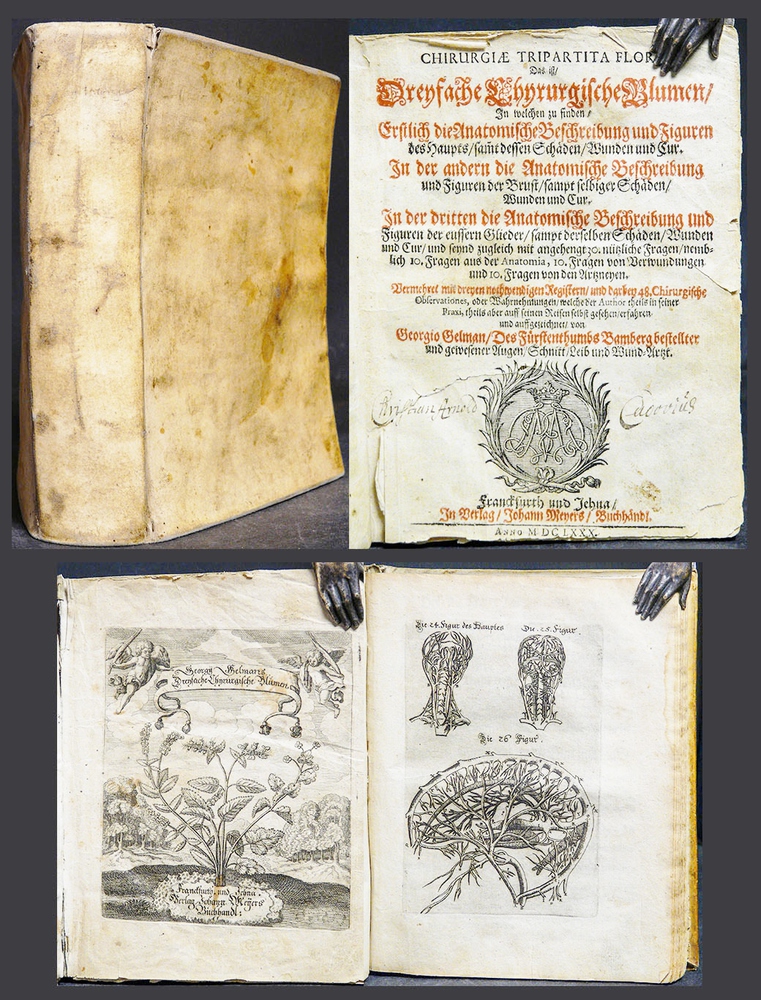
Gelman, Gregorius (d. 1672): Churgiae tripartita flora, das ist dreyfache chyrurgisches Blumen, in welchen zu finden, erstlich die anatomische Beschreibung und Figuren des Haupts, sammt dessen Schäden, Wunden und Cur. In der anderen die anatomische Beschreibung und Figuren der Brust – Old and Rare
€950,00
Georgius Gelman (- d. 1672)
CHIRURGIAE TRIPARTITA FLORA D. IST,
DREYFACHE CHYRURG. BLUMEN, IN WELCHEN ZU
FINDEN, ERSTL. D. ANATOM. BESCHREIBUNG U.
FIGUREN D. HAUPTS, SAMMT DESSEN SCHÄDEN,
WUNDEN U. CUR ; IN D. ANDERN D. ANATOM.
BESCHREIBUNG U. FIGUREN D. BRUST, SAMPT
SELBIGER SCHÄDEN, WUNDEN U. CUR ; IN D.
DRITTEN D. ANATOM. BESCHREIBUNG U. FIGUREN D. EUSSERN GLIEDER, SAMPT
DERSELBEN SCHÄDEN, WUNDEN U. CUR ; U. SEYND ZUGL. MIT ANGEHENGT
NÜTZL. FRAGEN, NEMBL. 10 FRAGEN AUS D. ANATOMIA, 10 FRAGEN VON
VERWUNDUNGEN U. 10 FRAGEN VON D. ARTZNEYEN.
Franckfurth und Jehna, In Verlag Johann Meyers, M.DC.LXXX, (1680)
Description : [small 4to] – pp. [8], 488, [38] + 36 copper engrav. plates and frontispiece
MEDICINE. CHIRURGY. ILLUSTRATED.
Second edition (1680) a reprint of the 1652 edition
published under title: Tripartita; das ist, Dreyfache chyrurgische Blumen by the German
physician Georgius Gelman, the work is organized in three sections. The first part describes
in details the anatomy of the human head, many sorts of possible injuries, problems and
diseases which might occur as well as the way to cure
pathologies and wounds related to the head. Among possible
remedies the author describes the procedure and way to use the
surgical instruments to perform cranium trepanation (pp.263 and
following) in which a hole is drilled into the skull, thus
exposing the dura mater in order to supposedly treat intracranial
problems, it is worth mentioning that the procedure was quite
common at the times even though it often resulted in the death
of the patient mostly due to infections. In the modern era it is
used only to treat epidural and subdural hematomas, and for surgical access for certain other
neurosurgical procedures, such as intracranial pressure monitoring. The second and the third
parts treat respectively of the anatomy, injuries and diseases of internal organs and bones
located in the torso and in the upper and lower limbs. The
book is enriched completed by a wonderful set of copper
engraved tables portraying the different part of the
human body, including bones, muscle, veins, nervous
and lymphatic system, brain and in the end a whole set
of antique medical and surgical instruments.An
intriguing XVII century surgery book in contemporary
full parchment binding, engraved allegoric frontispiece,
double coloured title page in red and black, woodcut
head and tail pieces in the text and some decorated
initials, nice gothic typeface, a few marginal tears in some pages due to use as this book was
very probably a practical reference text for physicians, some tears also affect the lower inner
side of title page close to the printer’s device with frayed external margins, some tears also to
the engraved tables in the end, usual foxing and moderate spotting due to age, last leaf of the
REGISTER almost flying freely due to a vertical tear, for the rest good. A fascinating antique
book of medicine.
Cfr.: AA.VV. Bericht über das Wirken und den Stand des historischen Vereins zu Bamberg, Bamberg
1845, p. 43, n.363. VD17, Das Verzeichnis der im deutschen Sprachraum erschienenen Drucke des 17
Jahrhunderts, Bibliography of German Imprints of the XVII Century, ref. 39:146142V ; COPAC UK
Wellcome Library of Medicine, ref. EPB / B24287/B.


